


Insurance payments look like regular subscription billing on the surface. However the importance of payment statuses is quite different. A failed payment may cause the policy to lapse which creates a major event for the customers and carriers.
Getting insurance premium collection right means understand your customer profile to offer them the right payment method, a payment experience that fits each sales channel, and treating payment status as operational data.
Let’s discuss some key components of successful payments for insurance industry.
Request your numbers
If you want to see how much of your insurance payments are failing and how much you can recover, reach out for an audit:
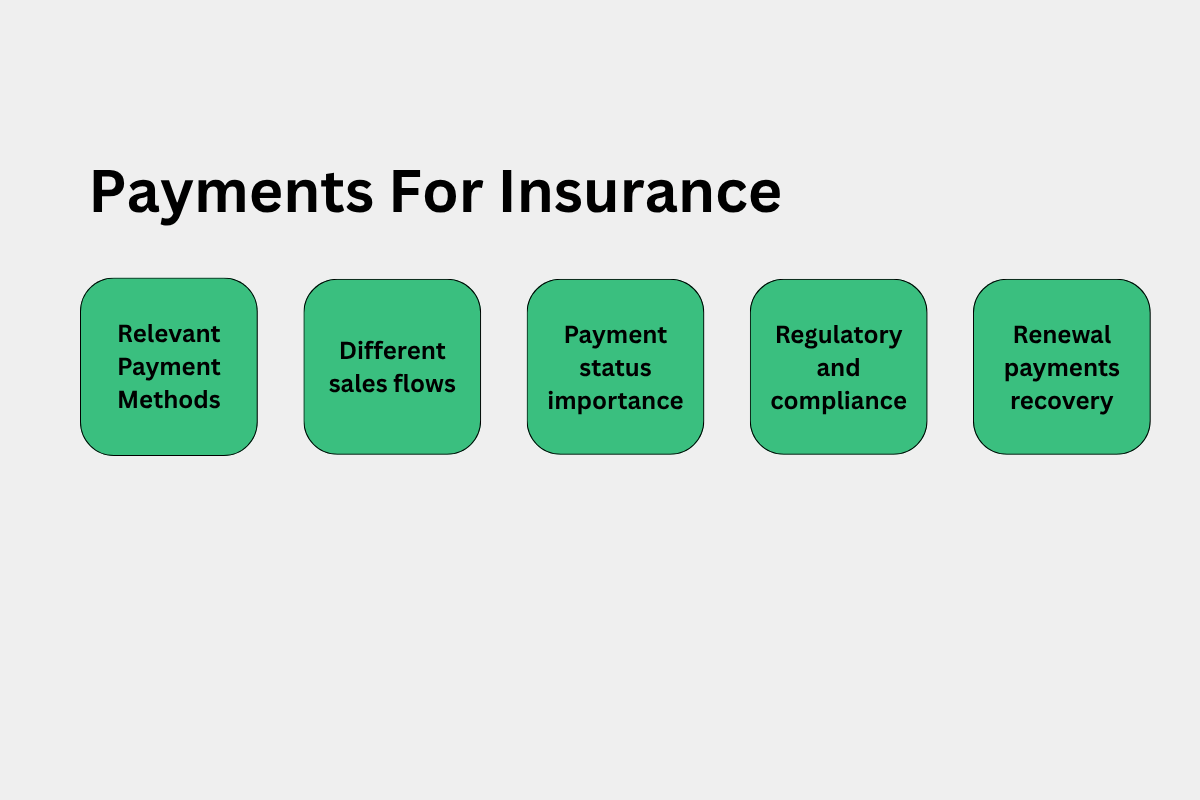
Provide relevant payment methods
There is no default payment method for insurance. Offering the wrong method creates friction at enrollment. The right method depends on who the customer is, how they were sold the policy, and what environment they are paying from.
Some customers buy a renters or auto policy through a mobile app and expect to pay with Apple Pay in two taps.
Some are older homeowners who have always paid by check.
Some policies are sold by agents and they collect payment methods from the customer. In this case the tipical payment methods are cards and ACH.
It is a key to understand your customer profile before designing the payment experience.
Different sales flows require different payment setups
Insurance is sold through several distinct channels, and each one creates a different payment context.
Direct digital — the customer buys online or in-app, completes the flow themselves. Cards, ACH via Plaid or similar, and mobile wallets (Apple Pay, Google Pay) all fit here. The experience should be fast, the authorization captured at the point of sale, and the recurring setup confirmed immediately.
Agent-assisted — an agent quotes and binds the policy over the phone or in person. The customer may not be at a device. This requires a different payment setup: a virtual terminal the agent can use to capture card details, a payment link sent by SMS or email for the customer to complete on their own.
In some cases a paper check or a bank numbers are collected in person. Payment capture cannot depend on the customer being in an app.
In other cases, the payment methods are collected by phone using the MOTO mode.
The mistake is building one payment experience and assuming it covers all. Building payment infrastructure that supports each channel separately is more work upfront but reduces friction across the board.
A failed payment means no coverage
Unlike almost any other recurring payment context, failure here has an immediate consequence for the customer. The policy either lapses or enters a grace period (typically 10 to 30 days), depending on state and policy type. If the grace period passes without resolution, coverage ends.
This means an insurer needs to know in real time (not at month-end) whether a premium was collected.
If the ACH debit returns R01 (insufficient funds) on the 3rd, and the grace period is 10 days, there is a narrow window to re-notify the customer, re-initiate the debit, and confirm collection before lapse.
Renewal payments are harder than they look
Renewal billing looks like a subscription but behaves slightly differently. In most subscription businesses, a portion of customers manage their payment methods. Insurance customers generally do not. They set up auto-pay at enrollment and then forget about it. The result is that renewal periods generate a spike in returns from stale account data and closed accounts.
The regulatory layer
Accepting a premium from someone who has no relationship to the policy creates regulatory exposure and potential fraud vectors. The practical check is to verify that the account holder or cardholder matches the named insured or an authorized party before processing. In consumer lines the policyholder and payer are usually the same person.
There are also several rules apply directly to insurance payment operations.
NACHA thresholds. Any insurer originating ACH debits must keep overall return rates below 15%, administrative returns below 3%, and unauthorized debits (R07, R10) below 0.5%. Exceeding these triggers corrective action from the originating bank, up to suspension of ACH origination privileges.
Authorization. Written or electronic authorization is required before debiting a consumer’s bank account. For recurring payments, the authorization must specify the payment schedule and give the consumer a clear path to stop payments.
State grace period laws. Most states mandate a minimum grace period before lapse for non-payment. Billing retry logic needs to be designed around these windows, not against them.
PCI DSS. If the insurer stores, processes, or transmits cardholder data, PCI compliance applies. Most insurers delegate this to a compliant processor, but the compliance obligation does not transfer with the data.
Next steps
Audit your ACH performance.
Reach out to us to audit your payments performance.
ACH Recovery Framework

When an ACH payment fails, many teams don’t retry or retry it once and move on. Some of those payments are recoverable and some are not. Treating them the same way leaves money on the table and can create compliance problems. This guide is the framework I use to work through them.